

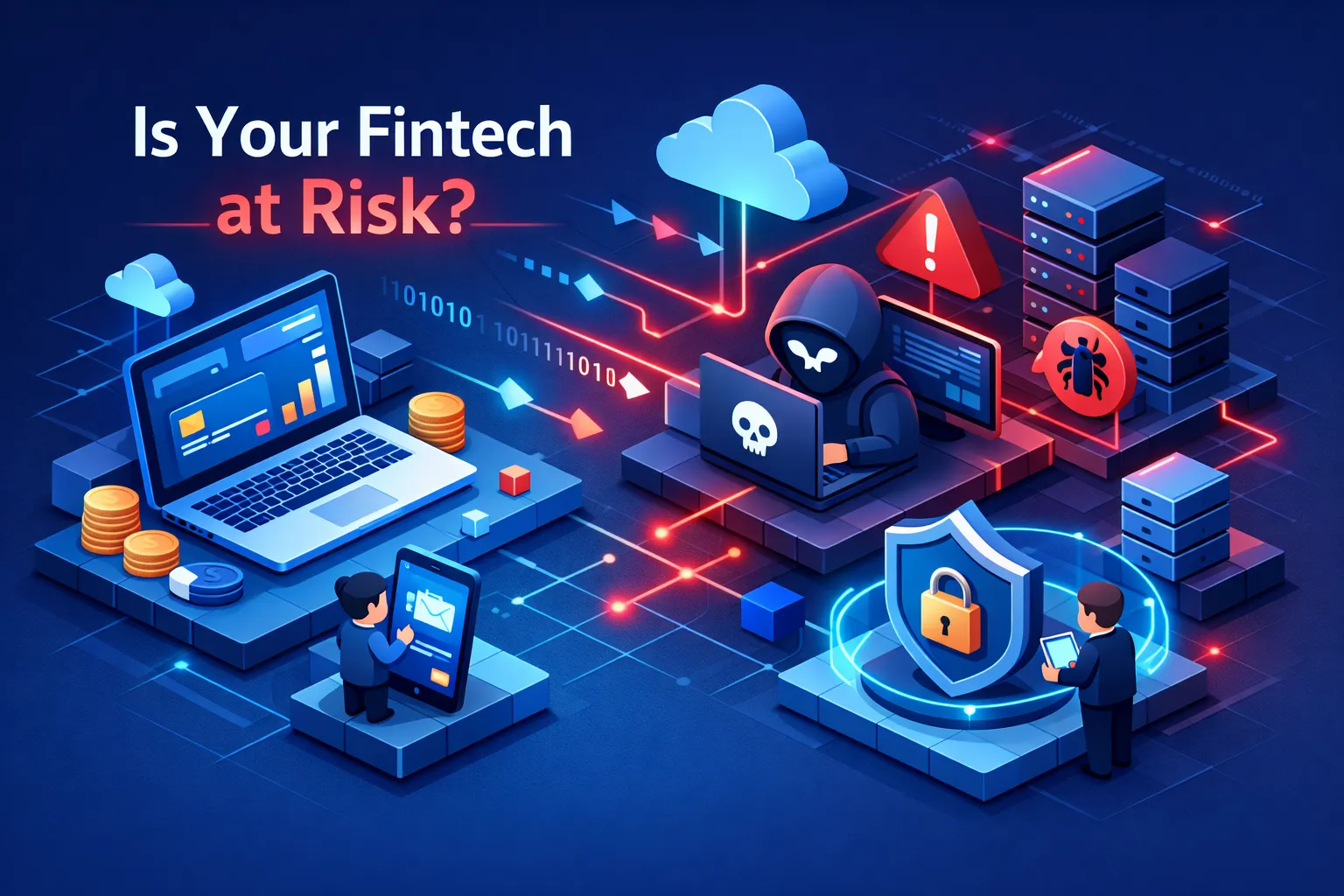
The "too small to target" myth
There is a persistent myth among early-stage founders that cybercriminals only go after the "big fish" like Tier-1 banks or massive e-commerce platforms. This is fundamentally untrue.
Hackers do not check your LinkedIn employee count or Crunchbase profile before launching an attack. They run highly automated, decentralized scanners across the entire IPv4 address space. These scripts are endlessly looking for exposed APIs, misconfigured AWS S3 buckets, unprotected authentication endpoints, and unpatched known vulnerabilities. A 10-person fintech startup managing 50,000 user accounts with linked payment credentials is an infinitely more attractive target than a mid-sized retailer with zero financial data.
Finance is the second-most breached sector globally, accounting for a massive 22% of all cyberattacks in 2023. By 2025, over 72% of banks worldwide reported being targeted by sustained, sophisticated attacks. For a deeper, Nigeria-specific view of the local threat landscape, read our analysis on why Nigerian fintechs are prime targets.
What hackers actually want from your fintech
The motivation is entirely financial. Attackers target fintechs to extract assets that can be easily monetized on the dark web or through decentralized exchanges.
- Identity Data (PII): A complete "fullz" profile - which includes a user's name, address, Date of Birth, BVN, and NIN - sells for $10 to $100 per record. This data is used to open fraudulent accounts elsewhere.
- Payment Credentials: Stolen credit card details run $5 to $120 depending on the balance and freshness. Banking credentials with verified, active account access can fetch several hundred dollars.
- Direct Fund Extraction: Beyond reselling stolen records, attackers aggressively use account takeover (ATO) tactics to initiate fraudulent transfers, drain user digital wallets, and abuse your automated payout APIs.
The technical mechanism for these thefts often involves manipulating API parameters. For a deep technical dive into how attackers alter payment endpoints, read our breakdown of the most dangerous API vulnerability in payment platforms (BOLA).
9 signals that make your fintech highly visible to attackers
Attackers prioritize targets that display specific weaknesses. Here are the 9 signals that tell an attacker your fintech is ripe for exploitation:
1. Open, undocumented APIs
If your public-facing APIs lack strict rate limiting, robust token validation, and comprehensive API security controls, attackers will systematically probe them until they find a logic flaw.
2. Broad third-party vendor access
Over 41% of fintech breaches originate not from the core application, but from third-party vendors with unchecked, over-privileged access to the fintech's environment. If your KYC provider is breached, are your users protected?
3. Missing Multi-Factor Authentication
Credential stuffing attacks are entirely automated and incredibly low-cost. Without mandatory Multi-Factor Authentication (MFA), stolen passwords from other websites become direct keys to your users' wallets.
4. Aggregation of PII at scale
If you are storing BVNs, NINs, unhashed account numbers, and deep transaction histories without robust encryption at rest, you are building a high-value treasure chest for attackers.
5. Real-time payment rails
Startups heavily integrated with instant settlement rails (like NIBSS Instant Payment or crypto networks) are targeted because theft is immediate and often irreversible. There are no 3-day clearing windows to catch fraud.
6. Rapid, unchecked growth
More accounts equal a exponentially larger attack surface. When a startup scales from 10k to 100k users in a month, onboarding automation and product velocity almost always outpace security and fraud controls.
7. No dedicated security hire
When "everyone" is responsible for security, no one is. Unreviewed cloud configurations, default database permissions, and undocumented API changes accumulate into a massive technical debt of risk.
8. Unpatched dependencies
Your app might be secure, but the open-source libraries you rely on might not be. A single outdated NPM package or vulnerable Python library is all an attacker needs to gain initial access.
9. Poor offboarding processes
FinWise Bank was famously breached because a former employee retained access to sensitive files. Terminated employees or contractors with lingering AWS or database access are massive insider threats.
Not sure how visible your fintech's attack surface is?
Get a Threat Exposure AssessmentWhat a breach actually costs a startup
The financial reality of a breach is often fatal for early-stage companies. Fintech startups face direct breach costs ranging from $120,000 to over $1.24 million per incident. This includes emergency incident response, mandatory forensic audits, customer notification costs, and severe regulatory fines from bodies like the NDPC or CBN.
Furthermore, roughly 60% of small businesses close permanently within six months of a significant data breach due to total loss of consumer trust and merchant churn. The average detection time for a breach in the financial services sector is a shocking 197 days, with containment taking an additional 69 days. This means an attacker could be silently extracting data and funds from your systems for over eight months before you even realize you are bleeding.
Proactive security is an investment with a measurable ROI. Organizations that conduct regular penetration testing save an average of $1.9 million per breach incident compared to organizations that rely solely on reactive measures.
How to reduce your exposure right now
You don't need a million-dollar enterprise security budget to drastically reduce your attack surface. Start with these high-impact fundamentals:
- Enforce MFA: Implement mandatory Multi-Factor Authentication across all internal admin dashboards and external user accounts.
- Audit Third Parties: Review every active third-party integration (payment gateways, SMS providers, analytics) and revoke any excess or unnecessary permissions. Implement principle of least privilege.
- Harden APIs: Review your API authentication layer. Implement strict rate limiting on every public endpoint, particularly login, password reset, and OTP generation routes to prevent automated fraud.
- Credential Rotation: Force a rotation of all overdue database passwords, AWS access keys, and third-party API secrets.
- Strict Offboarding: Treat employee and contractor offboarding as a critical security event. All access must be revoked within 60 minutes of termination.
Once the fundamentals are in place, you must test them. A focused API and authentication penetration test for a fintech startup typically costs between $5,000 and $15,000 - a fraction of the cost of a catastrophic breach. For specific details on what professional testing looks like, read our guide on how a Simpa Labs pentest works and review our transparent pricing guide.
Your attack surface is a direct business risk
Would hackers target your fintech? Yes. The infrastructure choices you make this week directly determine how easy you make it for them. Start with the immediate quick wins: enforce MFA, audit vendor permissions, and implement strict API rate limiting. Then, schedule external penetration testing as a core piece of operational intelligence, not just a box to check for compliance.
Frequently asked questions
Are small, newly launched fintechs really targeted by hackers?
Absolutely. Attackers use automated scanners that don't care about your company size or funding round. If your API is publicly accessible on the internet, it is being probed. Small fintechs are often preferred targets because they hold valuable financial data but typically lack the mature security monitoring teams of established banks.
What are hackers trying to steal from a payment startup?
They want three things: direct access to funds (via unauthorized API transfers), Personally Identifiable Information (PII) like BVNs and NINs which they can resell or use for identity theft, and valid credit card credentials that can be exploited on other platforms.
How do third-party integrations increase my fintech's risk?
Nigerian fintechs rely heavily on third parties for KYC (Smile Identity, Dojah), payments (Paystack, Flutterwave), and banking rails (NIBSS). If you over-permission a vendor, or if that vendor is compromised, attackers can use that trusted channel to pivot directly into your core systems.
How much does a typical data breach cost a fintech startup?
Beyond the immediate theft of funds, startups face regulatory fines (from the CBN and NDPC), legal fees, mandatory forensic investigations, and catastrophic customer churn. The average cost for a small financial services firm often exceeds $120,000 - a fatal blow for many early-stage companies.
Related reading
Blog: Why Nigerian fintechs are targeted · Top Nigerian vulnerabilities · 10 proven ways to defend your business
Guides: Breach risk assessment · Security checklist · How to book a pentest
Services: Penetration testing · Vulnerability assessment · Secure architecture review