

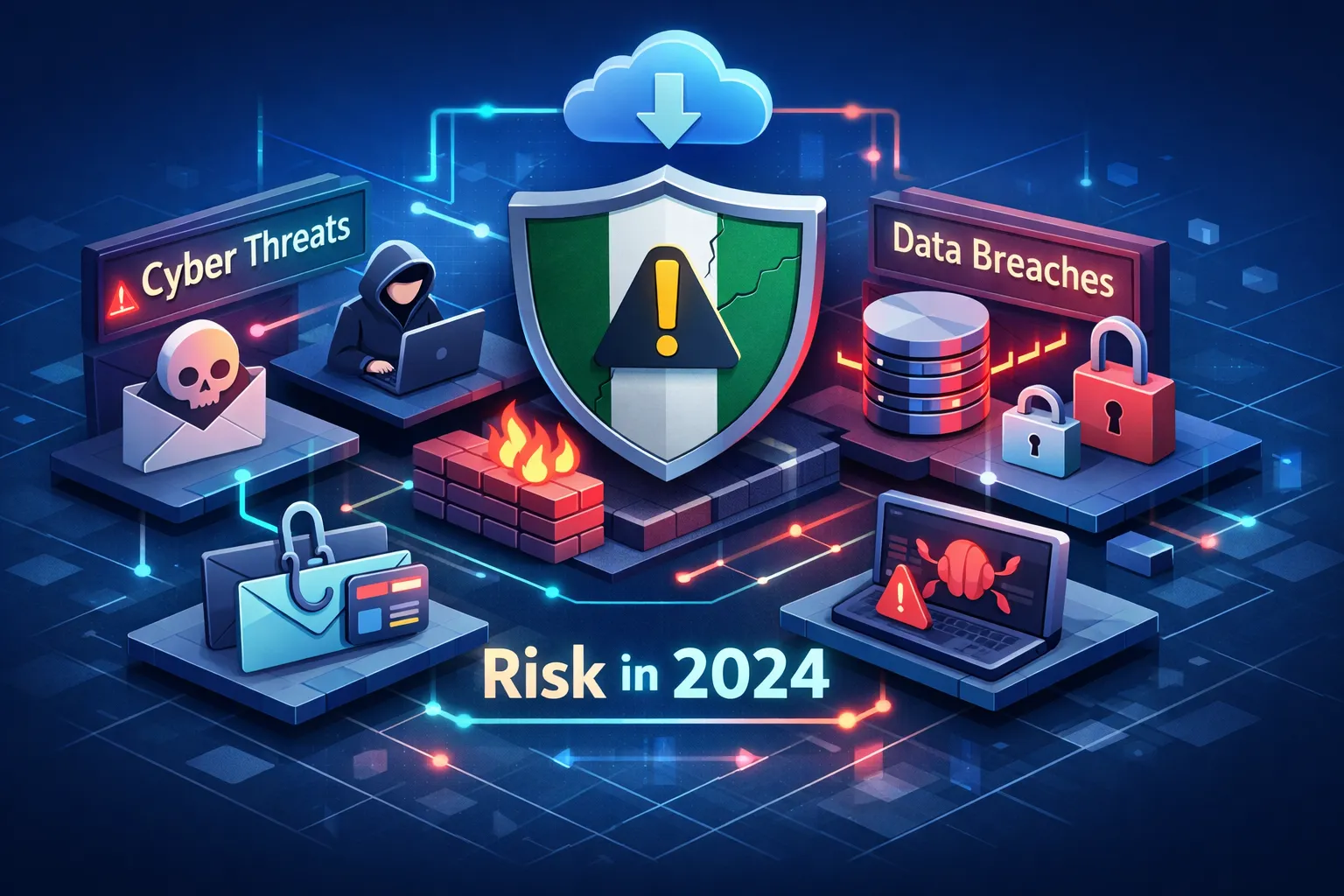
The numbers behind the Nigerian threat surge
The statistics from the last few years paint a grim picture for organizations relying on "security by obscurity." Overall cyberattack volume against Nigerian businesses rose 153% over a four-year period. Phishing campaigns targeting corporate credentials are up 178%. Malicious insider incidents climbed an alarming 92%.
In Q1 2025 alone, over 119,000 data breach records were logged locally. Nigeria ranked third in Africa for ransomware threat detections, with 3,459 documented incidents. The financial and telecommunications sectors bore the brunt, accounting for nearly half of all successful regional attacks. For a specific analysis of the financial sector, see our guide on why Nigerian fintechs are prime targets.
The root cause? Basic security hygiene is failing. Only 43.2% of Nigerian businesses have fully deployed Multi-Factor Authentication (MFA) across their workforce. Employee security training adoption sits at just 34%. The recent, highly publicized NIN data leaks, the LNRBDA government database dump, and the 60 million telecom records traded on dark web forums all share these exact root causes.
1. Unpatched software and outdated edge infrastructure
Ransomware operators do not write custom malware for Nigerian targets. They use automated scanners to scour the internet for companies running known, vulnerable versions of VPNs, firewalls, and routers. When they find an unpatched system, gaining entry takes seconds.
A prime example: the January 2025 LNRBDA government breach was definitively traced to compromised MikroTik router devices. The vendor had released security patches months prior, but the IT teams had failed to apply them. This is pervasive across Nigerian corporate networks where "if it isn't broken, don't touch it" is the prevailing IT philosophy.
The Fix: Vulnerability management cannot be manual. Companies must deploy automated OS and third-party application patch management tools (like Automox or ManageEngine). Furthermore, IT teams must adhere strictly to a Service Level Agreement (SLA) that requires critical, internet-facing vulnerabilities to be patched within 72 hours of a vendor release.
2. Weak identity controls and the MFA gap
The era of the password is over. The recent dark web sales of Nigerian banking credentials and high-profile cloud account compromises share a common thread: reliance on single-factor authentication and over-privileged default accounts.
Attackers use credential stuffing - taking millions of passwords leaked from previous breaches (like LinkedIn or Yahoo) and automatically trying them against your company's Office 365, VPN, or custom admin portals. Without MFA, a leaked password equals an immediate breach. Shockingly, over 91% of misconfigured cloud environments involve over-privileged IAM roles where developers are granted "Admin" access rather than "Least Privilege."
The Fix: MFA implementation is practically free via Google Authenticator, Microsoft Authenticator, or Duo. It must be enforced unconditionally for all staff, especially C-level executives who are frequent targets of Business Email Compromise (BEC) attacks. For advanced authentication architecture guidance, see our authentication security services.
3. Cloud misconfigurations and third-party vendor risk
As Nigerian companies rapidly migrate to AWS, Azure, and GCP, they are bringing on-premise security mindsets to the cloud. When a prominent consulting firm's AWS account was misconfigured, over 24,000 files including Nigerian passports and government IDs were exposed publicly to the entire internet without requiring a password.
Roughly 86% of all public cloud security incidents trace back to simple customer misconfigurations - like leaving an S3 bucket set to "Public Read."
Compounding this is vendor risk. The massive breach of 60 million Nigerian telecom records did not occur because the telco itself was hacked; it occurred because a third-party vendor with access to the telco's database was compromised. If you give a marketing agency direct access to your customer database, their weak security becomes your data breach.
The Fix: Deploy Cloud Security Posture Management (CSPM) tools to automatically detect and alert on misconfigurations (like open ports or public storage). Address vendor risk with strict security questionnaires, legally binding contractual security obligations, and tightly scoped API access. For a review of your cloud setup, see our secure architecture review.
4. Phishing and social engineering
Phishing attacks against Nigerian businesses rose 178% between 2020 and 2024. Attackers are no longer sending poorly spelled emails from foreign princes. They are sending highly convincing, context-aware emails impersonating the FIRS (tax authority), the CBN, or the company's own HR department.
With employee security training adoption at just 34%, the vast majority of Nigerian corporate staff have never been formally taught how to recognize these attempts. They click the link, enter their Office 365 credentials, and the attacker immediately sets up email forwarding rules to intercept invoices and alter bank payment details.
The Fix: Annual powerpoint presentations do not stop phishing. You must run simulated, benign phishing campaigns against your own staff monthly. For a practical guide to building these human defences, read our playbook on 10 proven ways to defend your business.
5. The surging insider threat
The most difficult vulnerability to patch is human greed or desperation. Insider incidents in Nigeria grew by 92% recently, with a massive 23.4% spike in Q2 2024 alone, heavily correlating with national economic pressures. Bank tellers, telco customer service agents, and fintech engineers are increasingly being recruited by external fraud syndicates to bypass technical controls, approve fraudulent loans, or export lists of high-net-worth individuals.
The Fix: Implement strict Role-Based Access Controls (RBAC). A customer service agent should not be able to export a CSV of 10,000 customers. Combine this with "Maker-Checker" (dual approval) rules for high-risk actions, clear acceptable use policies, and Data Loss Prevention (DLP) tools that alert when large amounts of sensitive data are accessed at unusual hours.
Not sure which of these vulnerabilities apply to your organisation's current infrastructure?
Get a Vulnerability AssessmentClosing the gaps: your remediation roadmap
You cannot fix what you cannot see. Start by gaining honest visibility into your environment with a professional vulnerability assessment. (Note: NITDA currently offers a free VAPT service for government institutions).
Implementing just four core controls addresses the vast majority of the vulnerabilities listed above:
- Automated OS and third-party patch management.
- Mandatory MFA across all employee accounts and VPNs.
- Regular, immutable, encrypted offline backups (to survive ransomware).
- Modern Endpoint Detection and Response (EDR) software on every company laptop.
What Nigerian law now requires of you
Ignoring these vulnerabilities is no longer just a technical risk; it is a massive legal liability. Under the Nigeria Data Protection Act (NDPA) 2023, companies must provide 72-hour notification to the NDPC following a data breach. You must appoint a Data Protection Officer (DPO) if processing data for more than 2,000 individuals annually, and file an annual data audit by March 15th. Non-compliance carries devastating penalties of up to ₦10 million or 2% of annual gross revenue. See our NDPR privacy checklist for compliance steps.
The gaps are known. Now close them.
The organizations that reduce their cyber exposure fastest do not buy expensive, complex AI security appliances. They start with the basics. A structured vulnerability assessment, a handful of low-cost foundational controls, and clear internal policies will close the gaps that most Nigerian businesses are currently leaving wide open to attackers.
Frequently asked questions
What is the most common cause of data breaches in Nigeria?
Despite the focus on advanced hackers, the vast majority of breaches in Nigeria stem from basic security hygiene failures: unpatched software (like outdated routers), misconfigured cloud storage buckets, and compromised employee passwords lacking Multi-Factor Authentication (MFA).
Why are Nigerian businesses seeing a massive surge in ransomware?
Ransomware operators look for easy targets. Because patch management is historically poor in many Nigerian enterprises, attackers use automated scanners to find known vulnerabilities, breach the network, and deploy ransomware before the IT team even knows an update was available.
How does the NDPA penalize companies for security vulnerabilities?
Under the Nigeria Data Protection Act (NDPA) 2023, if a vulnerability leads to a breach of personal data, the company can be fined up to ₦10 million or 2% of their annual gross revenue, whichever is greater, alongside severe reputational damage.
What is an 'Insider Threat' and how common is it in Nigeria?
An insider threat occurs when a legitimate employee misuses their access, either maliciously (e.g., selling customer BVNs to fraud syndicates) or accidentally. Due to economic pressures, malicious insider incidents grew by 92% recently, making it one of the fastest-growing threat vectors in the region.
Related reading
Blog: Why Nigerian fintechs are targeted · 10 proven ways to defend your business · Protect your business from hackers
Guides: Breach risk assessment · Security checklist · What to do after a breach
Services: Vulnerability assessment · Penetration testing