

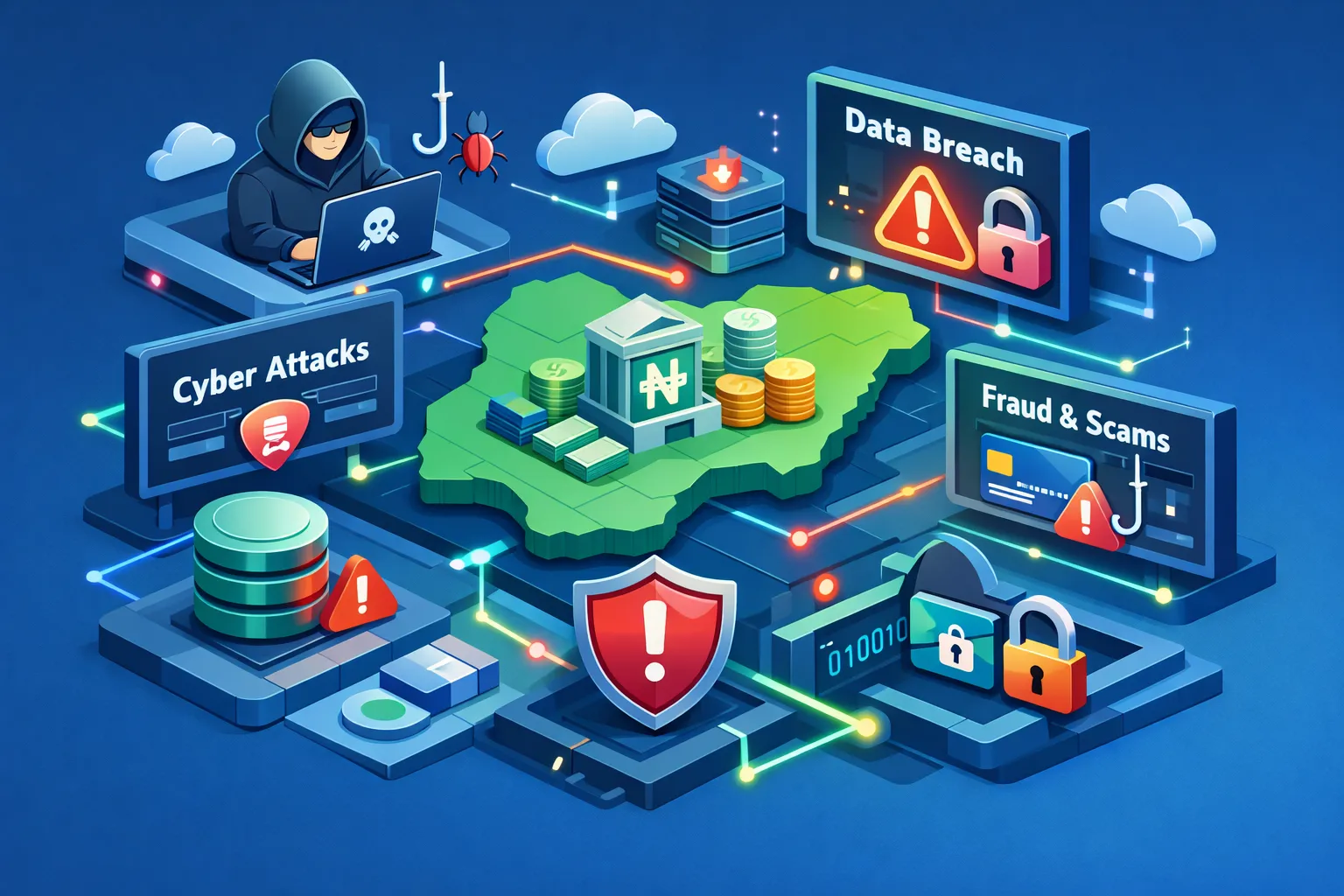
The scale of the problem is larger than most fintechs admit
Just how many attacks are Nigerian fintechs absorbing?
The 586,130 figure from H1 2024 covers financial institutions and telecoms tracked by a single managed security operations provider. Check Point's 2024 regional reporting puts the average weekly attack volume on Nigerian organisations at 3,759 across all sectors, with finance-specific organisations absorbing 4,718 attacks per week.
The trend line is the more alarming figure. A 153% rise in reported attacks from 2020 to 2024 isn't a spike, it's a sustained escalation. Ransomware grew 287% in the same window, and insider breach incidents rose 92%. What these numbers describe is an attack environment that has fundamentally changed in scale and sophistication, while most fintechs' security postures have not kept pace.
The financial losses that don't get headline space
The Nigeria Inter-Bank Settlement System (NIBSS) reported 11,532 fraud cases in Q2 2024, representing ₦56.3 billion in attempted fraud value. Full-year confirmed sector losses from completed fraud incidents exceeded ₦53.4 billion. In H1 2025, more than 150,000 Nigerian accounts were compromised. Estimates suggest losses exceeding ₦5 billion went unreported in early 2023 alone, pointing to a structural problem beyond the attacks themselves: underreporting prevents collective learning across the industry.
For a deeper look at how these breach patterns translate into concrete risk for your organisation, see our breach risk assessment guide.
The breaches Nigerian fintechs don't want you to know about
Flutterwave, Interswitch, and the insider threat problem
Flutterwave suffered ₦2.9 billion in unauthorised transactions in 2023, followed by an ₦11 billion loss in 2024. The method involved insiders exploiting workflow vulnerabilities, weak access segregation, and the complete absence of monitoring alerts. Interswitch's separate incident, driven by a system glitch that allowed merchants to file and receive fraudulent chargebacks, resulted in ₦30 billion in losses.
Both cases carry the same core lesson: the threat model for Nigerian fintechs cannot focus exclusively on external attackers. The absence of internal controls is itself a security vulnerability.
Compromised accounts sold on the dark web
In 2025, login credentials for accounts from Moniepoint, Kuda, Chipper Cash, and Paga appeared for sale on dark web forums. Moniepoint accounts were listed at $90 each, Kuda and Chipper Cash at $70, and Paga at $75. At $90 per account, an attacker buying a batch of 100 Moniepoint credentials is making a $9,000 investment with a potential return of multiples against individual account balances.
The pricing communicates something important about how attackers evaluate the Nigerian market: accessible enough to attack at scale, valuable enough to make bulk acquisition profitable.
Not sure how exposed your fintech is? Start with an honest assessment.
Get a Threat AssessmentHow hackers get in: attack methods targeting Nigerian fintechs
Phishing, SIM swap fraud, and social engineering
Phishing accounts for 90% of breaches in Nigerian businesses and grew 178% between 2020 and 2024. SIM swap fraud adds a mobile-layer attack on top: by socially engineering or bribing telecom staff to transfer a victim's phone number to an attacker-controlled SIM, fraudsters intercept SMS-based OTPs in real time. Nigerian fintechs that still rely on SMS OTP as their primary second factor are running a security model with a known, documented bypass.
For API-level defences against these attack chains, see our guide on securing fintech APIs against abuse in Nigeria.
BVN exploitation, API abuse, and credential stuffing
Broken access control, specifically BOLA and IDOR vulnerabilities, ranks as the most destructive OWASP vulnerability class found in Nigerian fintech security audits, allowing attackers to access accounts they shouldn't by manipulating identifiers in API calls. One exploitable endpoint can unlock access to thousands of accounts. For a technical deep-dive into this specific vulnerability class, see our article on the most dangerous API vulnerability in payment platforms.
Once attackers have bulk credentials from dark web purchases, they run automated stuffing attacks across multiple fintech platforms simultaneously. The dark web listings don't just represent past breaches; they actively fuel the next wave of account takeovers.
Insider threats: the risk that compliance teams underestimate
Insider breach incidents grew 92% between 2020 and 2024, with a 23.4% spike in Q2 2024 alone. In 2024, 49 bank employees were formally dismissed for fraud-related activity. Without role-based access controls and behavioural monitoring, a single colluding employee can reroute significant funds before any alert fires.
Why Nigerian fintechs are structurally easier to breach
Rapid growth outpaced security investment
Nigeria's fintech sector grew explosively across users, transaction volume, APIs, and third-party integrations. Security infrastructure rarely scaled at the same rate. Cross-border cybercrime networks specifically target newer platforms because the payoff-to-effort ratio is more favourable. For a broader view of common vulnerability patterns, see our analysis of top security vulnerabilities facing Nigerian companies.
Mobile-first design creates a wider attack surface
Nigeria's fintech adoption is mobile-driven, which pushes companies to optimise for USSD, in-app transactions, and SMS authentication. Each of these channels carries known vulnerabilities. The same design decisions that made Nigerian fintechs accessible to millions of users also made them more attackable.
What CBN and NDPC are now demanding from fintechs
CBN's escalating enforcement posture
The Central Bank of Nigeria imposed ₦1 billion in total fines on fintech players in 2024 for operational lapses. The CBN's Risk-Based Cybersecurity Framework requires licensed institutions to establish Cyber-Threat Intelligence programs, implement cybersecurity governance structures, and maintain operational resilience plans. The framework mandates third-party penetration testing at minimum annually. For details on meeting these requirements, see our CBN compliance guide.
NDPC compliance under the NDPA
The Nigeria Data Protection Commission requires fintechs handling Nigerian personal data to register as data controllers of major importance and submit annual data protection compliance audit summaries. Non-compliance is a legal exposure, not a reputational inconvenience. For a complete walkthrough of these obligations, see our NDPR/NDPA compliance guide and our detailed NDPR privacy checklist for fintechs.
What Nigerian fintechs should actually do to reduce their risk
The security controls that close the most common attack vectors
Given that phishing drives 90% of breaches and SIM swap bypasses SMS OTP, the first-priority controls are authentication upgrades and staff training. Replacing SMS-based two-factor authentication with authenticator apps or hardware tokens removes the primary SIM swap pathway.
On the technical side, the controls that produce the most coverage against documented Nigerian attack vectors are:
- API rate limiting and token validation to block automated credential stuffing attacks
- Endpoint monitoring to detect and respond to BOLA and access-control exploitation in real time
- Role-based access control with least-privilege principles to limit the blast radius of insider incidents
- Web Application Firewall deployment for all customer-facing platforms
- Behavioural monitoring and logging that can detect anomalous transaction patterns before significant damage occurs
For a structured checklist covering these controls, see our fintech security checklist and our detailed 10-point security self-assessment.
Starting with a penetration test calibrated to Nigerian threat patterns
Generic security audits miss the attack vectors specific to Nigeria's fintech environment. BVN-layer exploitation, SIM swap pathway testing, USSD session interception scenarios, and API abuse modelled on local fraud patterns require threat intelligence grounded in the Nigerian market. For a walkthrough of what a Nigeria-specific pentest engagement looks like, see how a Simpa Labs pentest works or our guide on how to book a pentest.
The evidence leaves no room for ambiguity
Nigerian fintechs are deliberate, commercial targets for attackers operating with specific knowledge of the local ecosystem. The exposure runs across three layers: technical (SMS OTP reliance, vulnerable APIs), structural (mobile-first attack surface, rapid growth without security investment), and operational (insider access failures, absent behavioural monitoring). The first move is an honest assessment of actual exposure.
Related reading
Blog: Would hackers really attack my fintech? · Top security vulnerabilities facing Nigerian companies · 10 proven ways to defend your business
Guides: Breach risk assessment · OWASP Top 10 for fintech · After a breach
Services: Penetration testing · Vulnerability assessment · For payment gateways and mobile money operators
Frequently asked questions
Do hackers specifically target Nigerian fintechs?
Yes. Nigerian financial institutions absorbed 586,130 detected cyberattacks in H1 2024 alone, with an average of 4,718 attacks per week on financial-sector organisations. Dark web pricing of Nigerian fintech credentials confirms deliberate, commercial targeting.
What are the most common attack methods used against Nigerian fintechs?
Phishing accounts for 90% of breaches. SIM swap fraud bypasses SMS-based OTP authentication. BOLA/IDOR vulnerabilities in APIs allow unauthorised account access. Credential stuffing uses bulk credentials from dark web purchases across multiple platforms simultaneously.
How much have Nigerian fintechs lost to cyberattacks?
Documented losses include ₦2.9 billion and ₦11 billion in unauthorised Flutterwave transactions, ₦30 billion from Interswitch chargebacks, and full-year confirmed sector fraud losses exceeding ₦53.4 billion in completed incidents.