

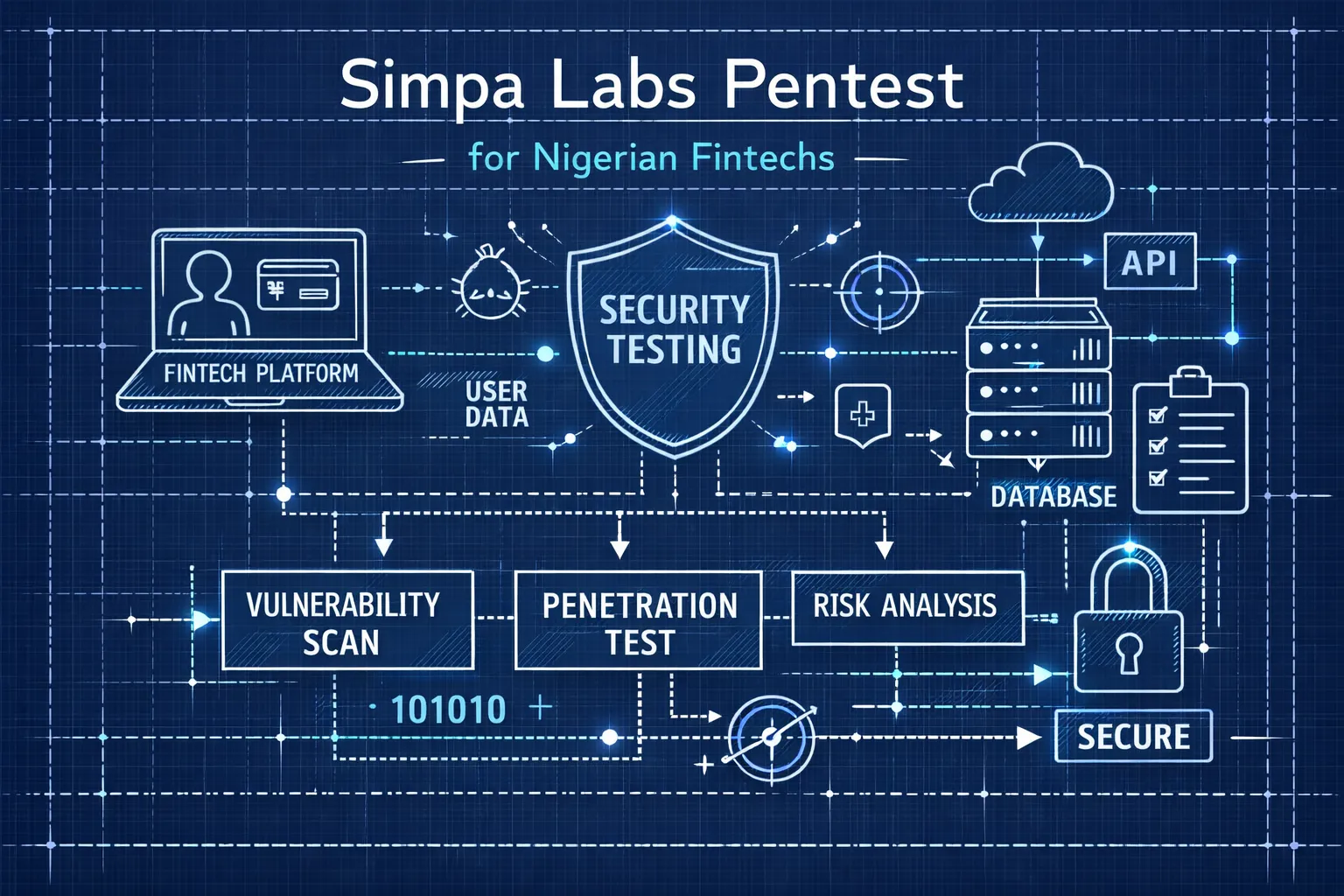
Why Nigerian fintechs cannot afford generic penetration testing
The CBN's Risk-Based Cybersecurity Framework places an explicit obligation on licensed fintechs to conduct regular vulnerability assessments and penetration testing. This is not a vague guideline. "We ran an automated scan" will not satisfy an examiner who understands what they are looking at. For a concise overview of the CBN's Risk-Based Cybersecurity Framework, regulators and practitioners have summarised the core obligations.
The NDPR and the Nigeria Data Protection Act 2023 require annual compliance audits and Data Protection Impact Assessments for entities processing financial personal data at scale. PCI DSS mandates specific technical controls for payment data security. A penetration test scoped without those frameworks in mind is not testing what your regulators actually care about. For details on meeting CBN requirements specifically, see our CBN compliance guide.
Phase 1: Scoping and surface mapping
The first one to two days are alignment days. Both sides agree on what is in scope, which environments will be used, what credentials and documentation will be shared upfront, and which flows carry the highest business risk. Timelines get locked in, escalation contacts get named, and the engagement structure gets formalised.
Choosing the right testing approach
Simpa Labs recommends grey-box testing as the starting point for most Nigerian fintechs. Grey-box gives testers enough internal context to target high-risk areas like payment flows and authentication chains efficiently, without spending the first two weeks on blind reconnaissance. Black-box simulates a fully external attacker. Red-team engagements run adversarial simulations across people, processes, and technology.
Environment setup and escalation paths
Testers need a dedicated test environment or a clearly sandboxed production replica before engagement begins. Your team should also agree upfront on who gets notified if a critical vulnerability surfaces mid-engagement. That escalation path needs to be established before testing begins. For more on preparation, see our guide on how to book a pentest.
The fintech components covered in a Simpa Labs pentest
- Payment flows: Initiation, processing, reversals, and authorisation checks between each step. Race conditions in disbursement logic, gaps in reversal validation, and authorisation bypasses.
- Authentication chains: OTP-based verification, BVN-linked identity, session tokens, account recovery flows. See our authentication security service.
- API security: Authorisation flaws, rate limiting weaknesses, data exposure risks, endpoint logic. For lending platforms, this extends to scoring engine endpoints and webhook security. See our API security service.
- Admin & back-office tools: Excessive privilege in internal systems is one of the most consistently damaging vulnerability classes in fintech.
- Mobile applications: Data at rest and in transit, session state management, client-side control bypass.
Ready to scope a penetration test for your fintech?
Book a Scoping CallWhat four to five weeks of manual exploitation looks like
Simpa Labs runs manual penetration testing as the primary method. Automated scanners cannot tell you that your payment reversal flow can be triggered twice under a specific race condition. A human tester who understands payment systems can. Findings are manually verified before they reach the report, so developers are not spending remediation time chasing scanner noise.
Testers chain vulnerabilities. A rate-limiting weakness on its own might be a medium-severity finding. That same weakness combined with a subtle flaw in OTP verification logic becomes something far more serious. The goal throughout is to demonstrate real business impact. When a critical finding surfaces, your designated escalation contact gets notified before the final report is assembled.
Deliverables and the retest cycle
The final report serves two audiences:
- Executive summary: For board members, compliance officers, and investors who need to understand the security posture without parsing technical scoring vectors.
- Technical findings: Each vulnerability documented with severity scoring, weakness classification, and detailed reproduction steps a developer can follow.
After your team addresses findings, targeted tests are rerun. A finding is not closed until it has been retested and verified as fixed. That status is reflected in the updated report.
The letter of attestation confirms the scope and completion of the test without disclosing the vulnerabilities. This is the document you share with regulators during a CBN audit, with enterprise clients, and with investors conducting technical due diligence.
How to prepare your team
Have a test environment configured, API documentation organised, and test credentials ready before day one. Align your development team ahead of kickoff: penetration tests surface uncomfortable findings, and the right framing going in is that the test exists to find what needs fixing before a malicious actor finds the same things.
For a full preparation checklist, see our how to book a pentest guide. For methodology details, see our tools and methodology page.
A pentest is not a pass/fail audit
There is no threshold score you either clear or miss. A well-run penetration test surfaces where your product's security assumptions break down under deliberate pressure. That information is valuable regardless of what it contains.
Related reading
Blog: Is Simpa Labs right for Nigerian payment startups? · Penetration testing in Nigeria: the complete guide · Do fintechs need a security audit before launch?
Guides: How to book a pentest · Tools & methodology · Pentest pricing guide
Services: Penetration testing · Vulnerability assessment