

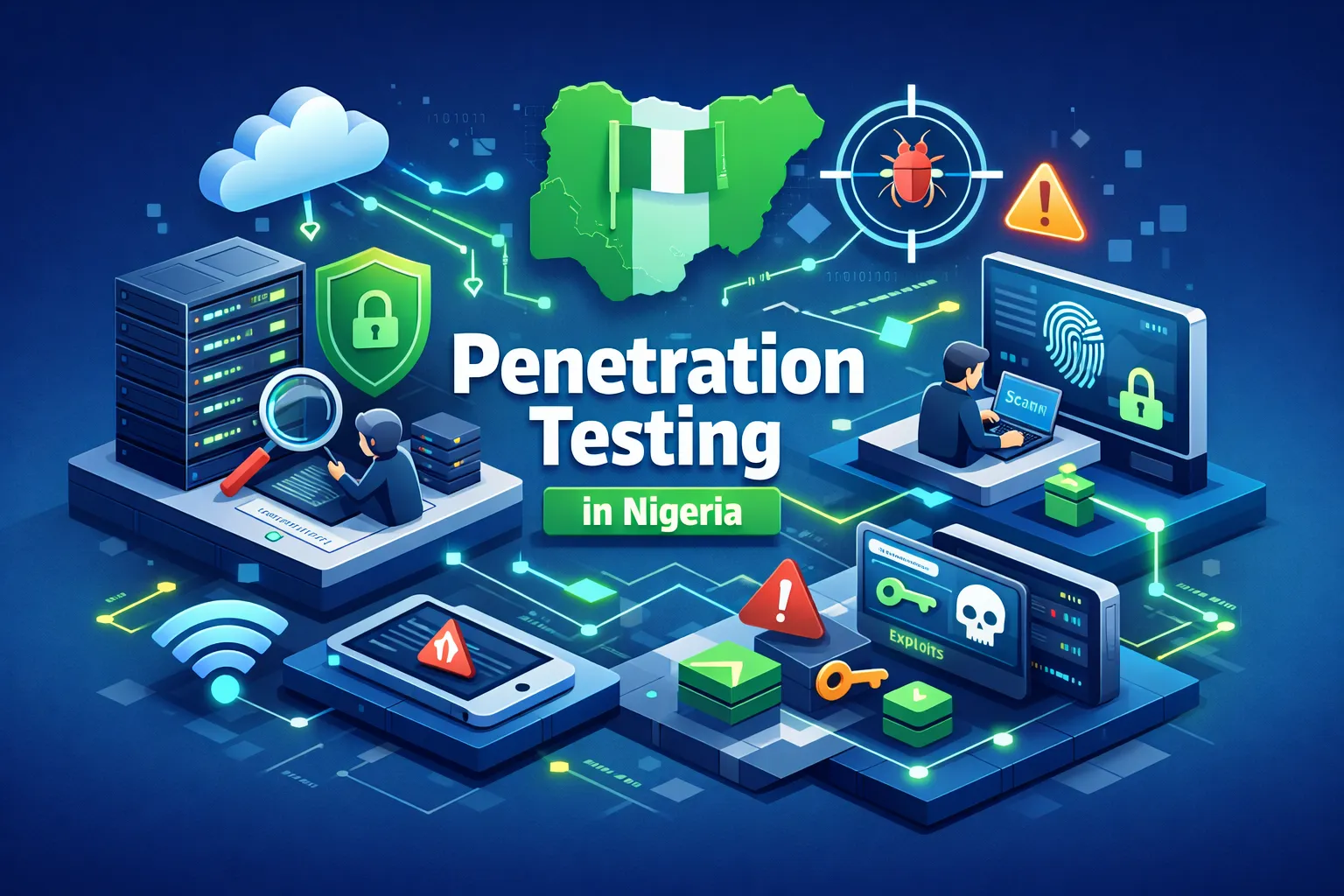
What penetration testing actually covers
Many Nigerian businesses buy a "penetration test" but receive a glorified automated scan. It is critical to understand the difference. A vulnerability assessment (VA) uses automated tools (like Nessus or Qualys) to identify missing patches and known weaknesses. It is broad, shallow, and generates hundreds of false positives.
A true penetration test (pentest) relies on a human security engineer. The engineer takes the output of the automated scan and actively attempts to exploit the vulnerabilities. They chain small flaws together to achieve a major breach (e.g., combining a low-severity information leak with a medium-severity SSRF to completely bypass a firewall). The combination of these two approaches is called VAPT (Vulnerability Assessment and Penetration Testing), which gives you the complete picture. For a detailed comparison, see our VA vs penetration testing guide.
Primary testing domains
Web Application & API
Testing user login portals, admin dashboards, and underlying REST/GraphQL APIs. This is the most commonly requested type of test for fintechs and e-commerce platforms. See our web app pentest guide.
Network Infrastructure
Testing internal and external infrastructure: firewalls, routers, active directory environments, and network segmentation controls to see if an attacker can move laterally.
Mobile Application
Reverse-engineering iOS and Android APKs. Testers look for hardcoded API keys, insecure local storage, and SSL pinning bypasses. Particularly relevant for mobile money operators.
Cloud Security
Auditing AWS, Azure, and GCP environments for misconfigurations, IAM privilege escalation gaps, and exposed S3 storage buckets.
Testing approaches: Black, Grey, and White Box
Black-box testing starts without inside knowledge of your systems. White-box testing gives the testing team access to source code and architecture diagrams for deeper coverage. Grey-box testing provides standard user credentials and tests the product as an authenticated customer. Grey-box is widely used for enterprise engagements. For full method details, see our tools and methodology guide.
Why Nigerian businesses face pressing cybersecurity risks
Financial services, telecommunications, and e-commerce are the most frequently attacked sectors in Nigeria. The pressure to achieve "speed-to-market" to capture venture capital has created a massive accumulation of technical debt in the ecosystem.
Startups are pushing code to production weekly without security reviews. Unpatched vulnerabilities, massively misconfigured cloud environments, and highly vulnerable legacy integrations (like integrating modern apps with older NIBSS or core banking APIs) are standard, routine findings in our first-time VAPT reports. For specific patterns, see our analysis of top security vulnerabilities facing Nigerian companies.
The Nigerian Regulatory Layer: NDPA, CBN, and NITDA
Penetration testing is no longer just an engineering best practice; it is a strict legal requirement in Nigeria.
- Nigeria Data Protection Act (NDPA) 2023: Under the NDPA, organizations processing personal data for more than 1,000 individuals within six months must conduct Data Protection Impact Assessments (DPIAs) and submit compliance audit returns. The NDPC is actively enforcing this, having completed hundreds of breach investigations. See our NDPR/NDPA compliance guide.
- CBN Risk-Based Cybersecurity Framework: The Central Bank of Nigeria mandates continuous monitoring, incident response readiness, and demonstrable security controls for all licensed entities. Annual penetration testing is explicitly required. See our CBN compliance guide.
- PCI DSS: If your application touches credit card data, PCI DSS Requirement 11 mandates both internal and external penetration testing at least annually and after any significant architectural change.
Ready to scope a regulatory-compliant penetration test for your Nigerian business?
Get a Scoping CallRealistic Pentesting Costs in Nigeria for 2026
Pricing for a penetration test is never flat; it is entirely scoped based on the complexity of the target. However, for budgeting purposes, here are realistic 2026 ranges for quality, manual testing:
- Web application pen testing: $4,000 - $30,000
- Mobile app testing (iOS & Android): $7,000 - $35,000 (per platform)
- Internal Network penetration testing: $5,000 - $25,000
- Cloud architecture security assessments: $10,000 - $50,000
- Full Red Team engagements (including Social Engineering): $40,000 - $150,000+
- Penetration Testing as a Service (PTaaS / Ongoing): $2,500 - $10,000/month
Most standard VAPT engagements run 1 to 3 weeks. Enterprise-level projects with extensive remediation and retesting phases extend to 30-90 days. For a highly detailed pricing analysis, read our pentest pricing guide.
How to vet a cybersecurity provider
The Nigerian market is flooded with IT firms claiming to offer penetration testing, when in reality, they simply run a Nessus scan, slap their logo on the automated PDF, and charge you $5,000. You must vet your provider aggressively.
Meet the engineer assigned to the test. Review a redacted report, ask for a finding walkthrough, and check the evidence, product logic, fix detail, and retest result. See how to choose a pentest company.
- Can the firm provide a sanitized, redacted sample report so you can evaluate their reporting quality?
- Can the assigned tester explain a relevant finding and show the evidence, impact, fix, and retest result?
- Is a free "retesting phase" (to verify you actually fixed the bugs they found) explicitly included in the scope and price?
- Do they have deep experience in your specific sector (e.g., do they understand NIBSS integrations if you are a fintech)?
- Is the exact testing scope, timeline, and rules of engagement documented in a formal Statement of Work (SOW)?
The 72-hour regulatory clock starts on discovery
Under Nigerian law, the time to understand your cyber exposure is before a breach happens. Once an attacker extracts your database, the 72-hour regulatory notification clock starts ticking. Start with a simple scoping conversation. Most qualified, ethical providers will give you a reliable cost range within one 30-minute call once they understand your technical environment.
Frequently asked questions
What is the difference between a Vulnerability Assessment and a Penetration Test?
A vulnerability assessment uses automated scanning tools to identify known weaknesses and generates a massive list of potential flaws. A penetration test (pentest) goes much further: a human security engineer actively attempts to exploit those weaknesses to determine exactly how far a real attacker could reach and what data they could steal.
Does the Central Bank of Nigeria (CBN) require penetration testing?
Yes. The CBN's Risk-Based Cybersecurity Framework mandates that all licensed financial institutions (Banks, MMOs, PSSPs, PTSPs) conduct comprehensive penetration testing at least annually, and crucially, after any major infrastructure or application upgrade.
How much does a penetration test cost for a Nigerian startup?
For a standard web application API pentest, a Nigerian startup should expect to pay between $4,000 and $15,000 depending on the complexity (number of dynamic pages, user roles, API endpoints). Full Red Team engagements for enterprise banks cost significantly more, often exceeding $50,000.
How long does a typical penetration test take?
Most standard VAPT (Vulnerability Assessment and Penetration Testing) engagements run for 2 to 3 weeks of active testing, followed by 1 week for report writing. Enterprise-level projects with extensive retesting phases can extend to 30-90 days.
Related reading
Blog: How a Simpa Labs pentest works · Security audit before launch · Security audit timing playbook
Guides: How to book a pentest · Pricing guide · Affordable pentest services
Services: Penetration testing · Vulnerability assessment