

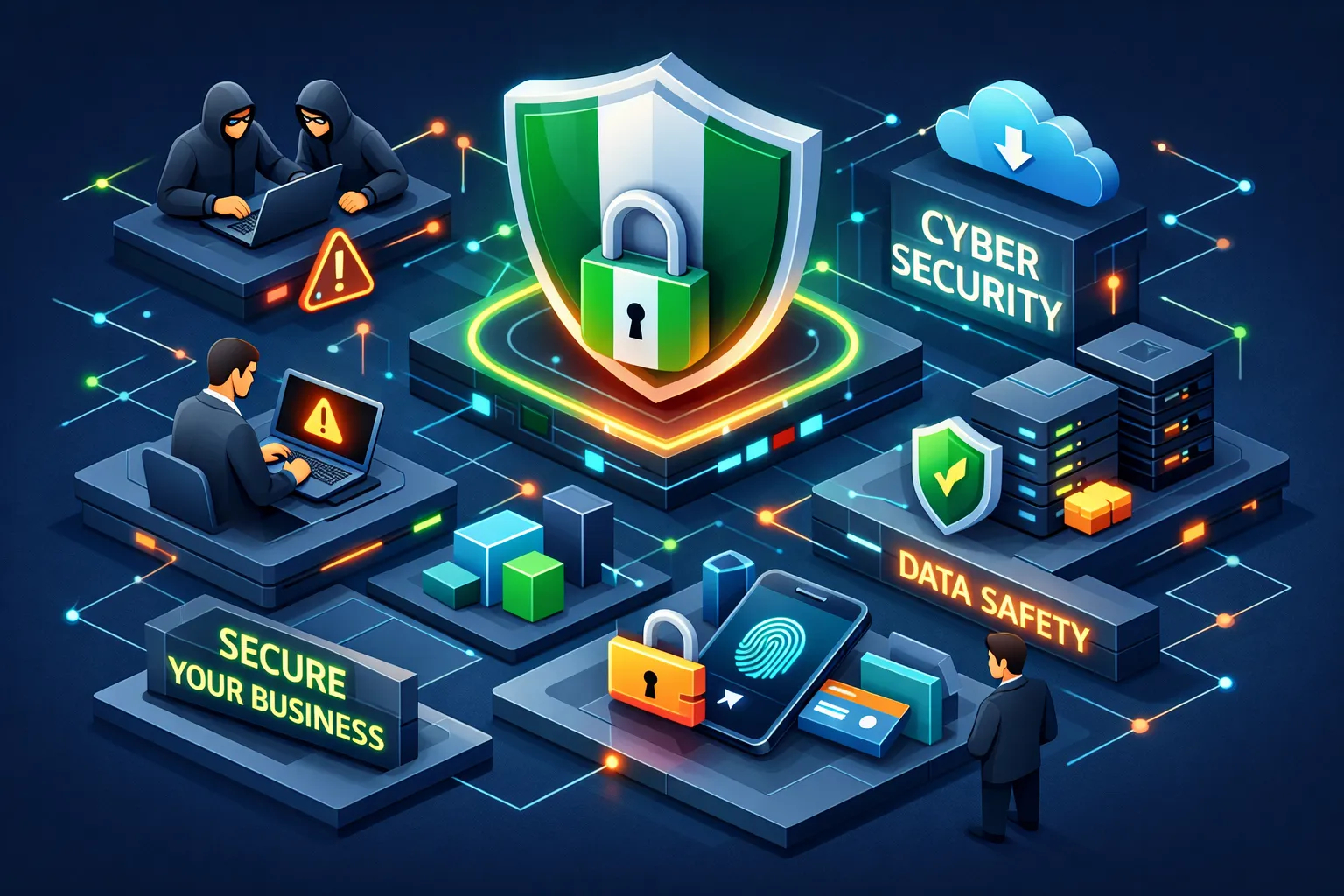
Why Nigerian businesses are getting hit harder than ever
The threat landscape in Nigeria has matured rapidly. Cybercrime syndicates are no longer solely focused on consumer scams; they have pivoted to sophisticated attacks against domestic businesses. In Q3 2025, Nigerian organisations faced an average of 6,101 attacks per week, a staggering figure that highlights the relentless nature of the threat.
The impact is severe. A single breach at a local healthcare provider recently exposed 130,000 patient records, leading to regulatory fines and catastrophic reputational damage. Phishing remains the undisputed king of attack vectors, representing the root cause of roughly 90% of successful breaches. Specifically, finance-related phishing targeting banks, payment gateways, and everyday businesses interacting with these platforms grew by 46% in H1 2025. Attackers know that smaller businesses hold exactly the data they want - customer lists, payment details, proprietary information - but critically lack the massive security investment of Tier 1 banks. For a deeper sector-specific analysis, review our breakdown of the top security vulnerabilities facing Nigerian companies.
1. Ironclad access control and Multi-Factor Authentication (MFA)
Multi-factor authentication (MFA) is unequivocally the single highest-return security action your business can implement today. It stops over 99% of automated account takeover attacks. The best part? Enterprise-grade MFA tools like Google Authenticator, Microsoft Authenticator, and Duo Security's fundamental tier are available entirely for free.
MFA must be mandatory across your entire infrastructure: business email (Google Workspace/Microsoft 365), accounting software (Xero, QuickBooks), cloud storage, payroll systems, and critically, every banking and payment portal. If you need assistance securing complex authentication flows in custom applications, review our authentication security services.
Beyond MFA, establish strict role-based access control (RBAC). Employees should only have access to the data necessary to perform their specific jobs. Audit these permissions monthly. When staff leave the organization, disable their accounts immediately - not tomorrow, not next week. Finally, mandate the use of a reputable password manager like Bitwarden or 1Password across the company to eliminate password reuse. For startups building financial products, consult our 10-point fintech security checklist.
2. Endpoint security and aggressive email protection
Every laptop, desktop, and mobile device connected to your network is a potential open door for attackers. Modern endpoint protection is non-negotiable. Solutions like Bitdefender GravityZone, Malwarebytes for Business, or Kaspersky Small Office Security are entirely cloud-managed, meaning you can deploy them effectively without needing an expensive on-site IT team.
Because phishing drives 90% of successful breaches, you must aggressively filter inbound communications. Configure advanced email filtering via SpamTitan, Proofpoint Essentials, or strictly enforce the built-in advanced threat protection features in Microsoft 365 and Google Workspace. But defending inbound email isn't enough; you must protect your own brand reputation from being hijacked.
You must configure DMARC, SPF, and DKIM records on your domain. Without these protocols, attackers can easily spoof your domain name, sending emails that appear to come from your CEO to phish your own customers or employees. This configuration takes approximately 30 minutes in your DNS settings and is a fundamental requirement for modern business.
3. Continuous staff training and security culture
Your security is only as strong as your most distracted employee clicking a malicious link at 4:45 PM on a Friday. Security awareness must be continuous, not an annual PowerPoint presentation. GoPhish is an excellent, free, open-source tool for running simulated phishing campaigns against your own staff. Run these simulations monthly.
Follow up these simulations with targeted, positive training. Focus your education on four critical behaviors:
- Recognizing the subtle patterns of modern phishing (urgency, spoofed domains, unexpected attachments).
- Creating a frictionless culture of reporting suspicious activity.
- Strictly using only approved, company-managed file-sharing tools (banning personal WhatsApp or unauthorized cloud drives for company data).
- Enforcing a multi-step verification process (e.g., a phone call) before transferring any funds based on an email request.
Document these expectations clearly in a straightforward, one-page acceptable-use policy.
Need a security partner with deep Nigerian market expertise?
Talk to an Engineer4. Resilient backups and encryption protocols
Ransomware attackers will attempt to encrypt both your primary data and your backups. To survive a ransomware attack without paying, strictly follow the industry-standard 3-2-1 rule:
- Keep three copies of your critical data.
- Store them on two different media types (e.g., local server and cloud).
- Keep one copy completely offsite and ideally offline (air-gapped).
Combine a local external hard drive with a reputable cloud backup provider (Google Drive Business, OneDrive, or specialized services like Backblaze). Automate daily cloud backups and perform weekly full backups to an offline external drive. Crucially: test your restores monthly. A backup you haven't successfully restored from is merely a theoretical backup.
5. Navigating NDPA 2023 compliance
Regulatory compliance is no longer optional. The Nigeria Data Protection Act (NDPA) 2023 is actively enforced. Key obligations for businesses include:
- Appointing a designated Data Protection Officer (DPO).
- Conducting mandatory annual privacy audits through a licensed Data Protection Compliance Organization (DPCO).
- Registering your organization with the Nigeria Data Protection Commission (NDPC) if you process data at scale.
- Honoring data subject rights (the right to access, delete, or port their data).
- Notifying the NDPC within 72 hours of discovering a significant data breach.
Failure to comply can result in severe financial penalties and public reprimands. Ensure your legal and technical operations align by reviewing our comprehensive Nigeria data protection guide and our detailed NDPR/NDPA compliance checklist.
6. Incident response: What to do when the worst happens
Hope is not a strategy. When a breach is suspected, immediate, decisive action minimizes damage. Do not panic, but move quickly:
- Isolate: Disconnect affected systems from the internet and the local network immediately.
- Preserve: Do not wipe devices or reboot servers. You must preserve all logs and forensic evidence for investigation.
- Lockdown: Change all potentially compromised passwords and immediately revoke suspicious active sessions.
- Identify: Attempt to identify the initial entry point without altering system state.
Remember your legal obligations: under the NDPA, you have exactly 72 hours to notify the Commission. For a step-by-step crisis playbook, read our after a breach guide and understand the NDPA breach notification process.
Your practical, week-one security checklist
Security is built incrementally. Start here: Enable MFA on all critical accounts today (it's free and takes 30 minutes). Deploy centralized endpoint and email protection by the end of the week. Run your first internal phishing simulation this month. Set up a 3-2-1 backup architecture and document a successful test restore. Finally, review your NDPA obligations and schedule your annual privacy audit.
Frequently asked questions
Why are Nigerian small and medium enterprises (SMEs) being targeted by hackers?
SMEs in Nigeria are heavily targeted because they often possess valuable data (customer financial records, PII, intellectual property) but lack the enterprise-grade security budgets of larger corporations. Attackers view them as 'soft targets' for ransomware and business email compromise (BEC) scams.
What is the most effective way to prevent unauthorized access to my business accounts?
Multi-Factor Authentication (MFA) is universally considered the most effective deterrent against unauthorized access. By requiring a second form of verification (like a time-based code from Google Authenticator or a hardware key), attackers cannot access accounts even if they successfully steal a password via phishing.
Does my small business really need to comply with the NDPA 2023?
Yes. The Nigeria Data Protection Act (NDPA) 2023 applies to any organization that processes the personal data of Nigerian citizens. Even small businesses must adhere to core principles like data minimization, securing data against breaches, and potentially registering with the NDPC depending on the volume of data processed.
What should be our immediate first step if we suspect a data breach?
First, isolate affected systems by disconnecting them from the internet and local network immediately to prevent lateral movement. Do not turn them off or wipe them, as this destroys forensic evidence. Next, initiate your incident response plan and notify legal counsel and the NDPC within the mandated 72-hour window.
Related reading
Blog: 10 proven ways to defend your business · Top Nigerian vulnerabilities · Data protection guide · Security audit before launch
Guides: NDPR/NDPA compliance · Security checklist · After a breach · Breach risk assessment
Services: Vulnerability assessment · Penetration testing · Secure architecture review